Friday, February 12, 2016

Openly Black: Is it safe to come out yet?

If you’re new to the BOTB and the sensitive type, you probably shouldn’t start with this post. Also I don’t really give warnings, so that’s pretty much the most you’ll ever get out of me going forward.


It’s February, and things are getting pretty black around here.


There are moments in life when you find yourself measuring time in increments of ‘before’ and ‘after’. February 2016 is already shaping up to be one of those moments for me. First, America  renewed my faith in democracy by saying NO to Trump. Then, Ta-Nehisi Coates criticized Bernie in such a way that over thirty new articles on reparations were written in under 15 days. Meanwhile, Cam Newton was busy being mistaken for Huey P. Newton because he had the audacity to enjoy being damn good at his job.


But the kicker, the moment that made it ‘before 2.16’ and ‘after 2.16’ in my mind was Beyonce’s live transition from consciousness in art to conscious artist as seen at super bowl fifty.


In case you have been living under a rock somewhere, here’s a quick 3SB on the whole SB50/HovNBey drama


3SB (Three Second Background)

  1. On Friday the 5th, Jay Z donated $1.5 million to Black Lives Matter
  2. On Saturday the 6th, Beyonce surprised the internet by dropping this lovely Ode to Blackness:
    Beyoncé - Formation (Dirty) from Michael Wells on Vimeo.


 3. On Sunday the 6th, Beyonce performed at the Super bowl, and her dancers wore this:
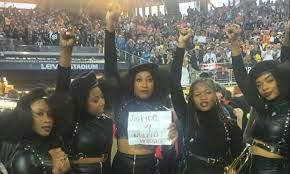

backup dancers guardian uk.jpg
Courtesy of Twitter


Yeah, so like I said, it’s getting pretty black around here; and some white people are not taking it very well. Like, boycott Beyonce not well. Former New York mayor Rudy Giuliani said he thought it was rude of Beyonce to use the super bowl to “attack the police.”


Now, this is where things get interesting. Why is it that when we are discussing the words or actions of a person of color, ‘criticize’ and ‘attack’ suddenly become synonymous? Coates took heavy criticism from his peers for his ‘attack’ of Bernie Sanders, even though every one of his articles specifically stated that he agreed with Senator Sanders on several issues. Beyonce, by speaking out about the unchecked slaughter of black and brown bodies, is perceived as ‘attacking’ the police.


An old adage comes to mind: don’t bite the hand that feeds you.


White supremacy thrives on an illusion of equality maintained through a system of black exceptionalism. By this I mean if there is no hope that one can become rich enough to ‘transcend race’, no Oprahs, Obamas, and Kanyes, the natives become restless.


It’s a delicate balancing act. Statistically speaking, whites are only comfortable with 8-10% nonwhite people in a given sphere. (So basically, Booker T. was right all along.) The unwritten rule of black exceptionalism is conformity to white normative ideas of blackness. Most importantly, blacks in the public sphere must strive to never remind people that they are in fact, black.


If they are rich and still black, then integration has failed. If they do choose to remind people that they are black, they must do it in such a way that makes blacks the butt of the joke (i.e. Kanye West, Flava Flav, Dennis Rodman). This rule has held true for so long we as blacks no longer even question it.


When discussing the Coates/Johnson argument with someone way smarter than me who’s been at this way longer than I have, they remarked: “Even (Barack) Obama can’t afford to be openly pro-black in this political climate.”
The weight of this bitter truth hit me like a paintball to the boob. We have a black president, yet at his final State of the Union address, he tap danced around the slaughter of the people who elected him and said something that basically equated to ‘all lives matter’.


I understood the choice. The president has an aggressive climate agenda, and he decided to prioritize the continued  existence of the planet over the concerns of one subset of his constituency.


Before February, I had come to terms with a black President that couldn’t openly advocate for black Americans. I was alright with a Presidential hopeful that sidestepped race in favor of political expediency. I was okay with waiting. But that was before I realized that I too, like my negro nose with Jackson five nostrils.


Before I started asking unthinkable questions, like:


  • If the richest 62 people could pay the deficit twice over and still have money left for an island or ten, why can’t we afford reparations?
  • Why is what Beyonce did an ‘attack’, and what Ammon Bundy did a ‘protest’? Neither took hostages.
  • Why are we only indicting Asian male police officers? Are Asians considered less white than I thought? Is this part of a larger agenda to divide and conquer minorities?
  • Are blacks really better off than we were before Civil Rights? Economically? Socially?
  • Why is George Washington a hero and Malcolm X a radical?
  • Why is it okay for a man to become a woman who loves women, but not for a black person to speak openly about black issues?
  • Why is it okay to be proud of being country, but ‘ghetto’ to be proud of being from the hood?
  • Why are black features adored on everything but black women (and men)?
  • Why do white journalists get to be individuals and black journalists have to be intellectuals/activists?
  • If we’re all Africans like Meryl Streep said (which we are), why isn’t African history studied worldwide?


... and while we’re at it


  • If we really care about drug epidemics, why aren’t we drone striking fields of poppies?
  • Why do grocery stores throw away food when 1 in 4 American children are starving? Other countries have laws against things like that.


I don’t have all the answers. But as black and white consciousness rises, I realize with pride that I am living in times where it’s (sorta) okay to ask the questions. 2.16 isn’t even halfway over, and already America has started a real conversation about race that is 400 years past due.


Perhaps the limits of our collective conscription have finally been reached. Perhaps, after the initial shock wears off, openly black Americans will find the type of reluctant acceptance that openly gay Americans now enjoy(?).


Or maybe Beyonce will get assassinated by a rabid ‘patriot’. It really could go either way.


One things is abundantly clear though: before 2.16, race was America’s worst kept dirty little secret. Now, by strokes subtle and bold, blacks of all flavors are finally starting to come out of the closet.

Saturday, February 6, 2016

Why everyone (except Tariq Toure) is wrong about Ta-Nehisi Coates, Part One

**This is part one of an I’m-not-sure-how-many-chunks-I-should-break-this-into-for-readability series.


When church member shared Ta-Nehesi Coates’ piece, Bernie Sanders and the liberal imagination with me on January 25th, I initially had this to say:


“Lillian*,


Thanks so much for sharing this with all of us! I enjoyed reading it and found myself challenged on several points as a Bernie supporter. Here's the problem though: Bernie Sanders is not a radical. If Bernie Sanders had run in 1992 or 1996 on the same platform he is pushing now, he would have been viewed as a populist, and life was, by every conceivable metric, better for black America then.


Bernie Sanders advocates for raising the minimum wage to $15/hr, which most of the country supports. But if wages were raised commensurate to the cost of living increased implemented since 1980, minimum wage would be around $25/ hour.


He advocates for making college free, which it is, in the majority of the developed world. Again, this is a populist idea that has been supported on both sides of the aisle.


If he ran in Canada or Great Britain, he would be in the Labour Party. And he would fall slightly right of center on that.


The fact that Bernie Sanders is viewed as a Leftist radical just serves to underscore how far the middle has moved in the past two decades. Ta-Nehisi Coates cites Abraham Lincoln as an example in his article, and while he pays tribute to the President's reluctance to sign the Emancipation Proclamation, he downplays one highly relevant detail of Lincoln's campaign: Abraham Lincoln was seen as a Populist. He gained his primary nomination by being more electable than the 'radical' William Henry Seward.


What we need is a truly radical leftist in the race; someone advocating for $30/ hr minimum wage, free healthcare, college, and graduate schooling, a national review of the legal code, tax code and public educational curriculum, salary caps on all companies who operate primarily on United States soil, reparations for Native Americans, Blacks, and Latinos, immediate release of all imprisoned persons, legalization of all drugs, supervised injection sites, an immediate redirection of 50% of all military spending directly to veterans, the dismantling of any banks that have been in existence longer than twenty years, and a host of other broad, sweeping changes that must be made for America to shift from a 'thing based society to a person based society'.


I guess what I am saying is I agree with the overall point of the article, but not the premise. I think I just discovered my next blog post.”


I was wrong. I was guilty of that infraction of which I so readily accuse others, forming an unqualified opinion. A few days later, pieces started coming out on Jacobin, Mother Jones, and even the Atlantic that had me feeling like I missed a beat, so I went back to TNC, and, sure enough, there was more to the story.


Turns out the piece I read first was just a chaser to wash down the stinging bite of January 19th’s Why precisely is Bernie Sanders against reparations?


There are about thirty reasons why I love this piece, but for your sake, dear reader, I’ll only share three:


  1. TNC is the king of dry delivery clapbacks. Watch him ‘do wut it do’: “Sanders says the chance of getting reparations through Congress is “nil,” a correct observation which could just as well apply to much of the Vermont senator’s own platform.”
  2. TNC drops words like Wayne freestyles-- with the bald faced braggadocio of a man who exists in a league of his own: “if Bernie Sanders truly believes that victims of the Tulsa pogrom deserved nothing...” I’ll save you a click. Pogrom means an organized massacre of a particular ethnic group.
  3. TNC is damn good at his job. A writer thinks before they write. A great writer thinks on the page, edits, and then thinks again. A social thinker writes for the specific purpose of expanding the Overton window on social issues.


Coates does this in both pieces by providing the public with more questions than answers. The proof of his genius is in the twenty plus articles that have come out so far this month on reparations. Agree or disagree, America is talking about something that was still unthinkable in most circles last Christmas.


I remember when our church first considered reading The Case for Reparations. It was in 2014. Our (now) youth pastor had joined the Black History Month committee and she suggested that maybe we should read an article instead of a book.


I was initially taken aback. I felt that after all the wine and cheese book studies and small group dinners I had been subjected to in the past five years, the ‘white folk’ could read a book instead of an article about black life.


That’s the thing about being black in a WASP denomination*. The war is slow and endless, waged over coffee or chardonnay, and every compromise tends to feel like a concession.


An article, no matter how long, felt like a slippery slope to me in 2014. If we read ‘A Case’ that year, what would stop us from reading an even shorter essay the next year? I was certain that by 2020 we would be having a small group dinner discussion on Langston Hughes’ Black Workers. We took a vote. I voted for Henrietta Lacks. I was wrong then too.


Not wrong in wanting to read a book instead of an article. Our snapchat society discourages the growth of print media. Books, even when they are produced, are being read on computer screens and readers with alarming regularity.


**Mini- rant alert:


Have we learned NOTHING for Fahrenheit 451? When books go, society follows in their wake.


Anyway, this year we reconsidered TNC’s controversial essay. In the wake of #TamirRice, we found our racial tolerance stretched thin already, the “litany of black bodies” proliferated by online and cable news outlets pushing both blacks and whites towards an (inevitably violent) implosion. Did we really want to push the envelope by bringing money into the conversation?


That was around the time that it finally clicked for me. Coates, Baldwin, Kitwana, Welsing, Alexander-- even Kendrick and Queen B were all parts of an incomplete analysis, they were all reaching across the ether to tell us, in their way: Change the conversation.


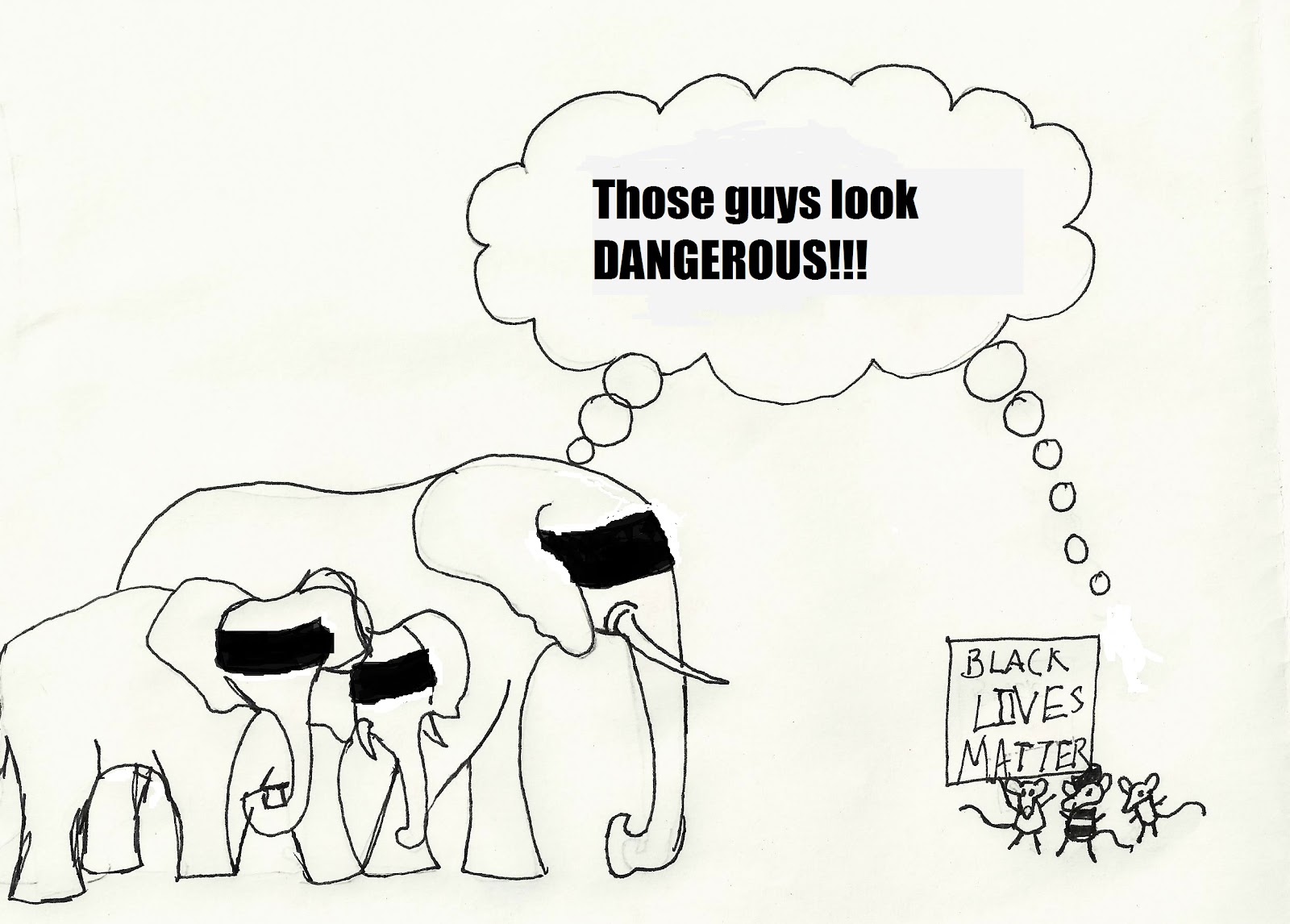
We (black Americans) can no longer afford to allow our white brothers and sisters to stumble through life like a herd of blindfolded elephants tromping through the jungle.


Blind elephants.jpg


James Baldwin’s words from Letter to my nephew, poignantly delivered by Chris Rock at last month’s #MLKNow Livestream keep replaying themselves in my mind:


“You must accept them, and you must accept them with love, for these innocent people have no other hope. They are, in effect, still trapped in a history in which they do not understand. And until they understand it, they cannot be released from it.”


“If the word ‘integration’ means anything, this is what it means: that we, will love shall force our brothers to see themselves as they are. To cease fleeing from reality and begin to change it.”


“We can make America what it must become.”


“We cannot be free until they are free.”


We cannot be free until they are free. We, black, white, brown, and glitter, will never be free having a conversation that is based upon a lie:

We no longer live in a white supremacist society.

... Stay tuned for Part II, coming soonish...

Tuesday, January 26, 2016

Spellcheck and Other Microaggressions


I hate spell check. Truly, I do.


Aside from the fact that it’s making America a country of lazy, shitty spellers, it is constantly reminding me in tiny ways that I’m not a real American.


Tonight it sneaks up on me when I am writing a cover letter for a job I would actually be excited to get up for. I finish, hit spell check, and immediately have to ‘ignore’ my first and middle names.


Hales, the name that the English immigrant who owned my forefather gave him, does not bear the telltale red line that indicates we have erred.


Ajah does. Diangella does. Nichol does. The names my mother gave me are, to Google, an error.


This shouldn’t be a big deal to me. But for some reason on this particular evening, it’s one paper-cut too many, and suddenly, I want to cry.


Nicole is okay. Nichol is an error. Let’s not even get into the fact that the O is supposed to have a ^ over it.

Now, I have come to expect a slight undertone of racism from Microsoft Word (don’t get me started on that paperclip). But this is GOOGLE we’re talking about! The organization the Feds get their scoop from!


Let me give you an example. A little over a year ago I was dating someone pretty seriously. We discussed rings and looked at a few together while I was logged into my Gmail. For months afterwards, I kept getting ads for Brilliant Earth, an ethically sourced diamond supplier.


Google knows where I live, what I eat, what I buy, even which kind of naughties I  like, but it doesn’t know my name.


I’m reminded of one of my sheros, Heben Nigatu of Buzzfeed and Another Round when she talks about her name and how immigration basically robbed her of her essential self.  I feel your pain, Heaven.


So in honor of Heaven, Tracy, and all of us ‘misspelled’ names that are magic for taking and holding space in a world that does not want us every single day, I’m going to do a top ten list of microaggressions white Americans should just not do.


Ten Microaggressions I really wish you wouldn’t...


10. Touch my hair.
9. Call me articulate with a tone of mild surprise.
8. Ask if I was on scholarship.
7. Assume I’m familiar with all black people, everywhere.
6. Call me a racist or accuse me of hating white Americans.
5. Ask me in a social settings if it is okay to use the ‘n’ word. It’s never, ever, okay.
4. Tell me “You're not really black.” Is that supposed to be a compliment?
3. Tell me, within five minutes of meeting me, that you know the perfect guy for me (the only other black person you know).
2. Touch my hair.


and the NUMBER ONE thing I wish you wouldn’t is:


  1. Ask me to speak on behalf of all black people, everywhere!

Friday, January 22, 2016

Choosing Change Part II: Fixing Global Inequality Starts with Black America


Oxfam published a report on Monday saying the wealthiest 1% have more money than the rest of the world combined. Initially, I felt defeated, both by the lack of conventional media coverage of this groundbreaking (if damning) data, and by social media’s lack of sustained pressure to discuss this inequity in the subsequent week.


Sixty two people have a combined worth of 1.67 trillion dollars, the same amount of money that the poorest 3.6 billion people in the world share. The report goes on to list statistics on carbon emissions versus impact that had me throwing up a little in my mouth. As my horror mounted, I tried to put this gross amount of money into a context that my fifth quintile mind could comprehend.


Sixty two people have 28 billion dollars each. How much is a billion? One hundred millions? Nope, google says it’s 1000 millions. Twenty Eight Thousand Millions still seems like an inconceivable sum. I try again.


Sixty two people can spend 1 million dollars a day for eighty years.


Sixty two individuals could take up a collection and pay the U.S. deficit-- and still spend 1 million dollars a day for fifty four years.


This isn’t make-it-rain money. It’s make-it-Katrina-money.


My first reaction was to get angry. The 1% are running our world, and they’re doing a piss poor job of it. It’s not even sixty two families! There are four Waltons, three Mars, and two Kochs on the list. These players and pimps are getting it in on elections, media, holidays, pharmaceuticals, banking, gambling, makeup, the internet, and television.


There is literally no way to avoid putting your money in one of their pockets.


Like the mythological Hydra of old (that’s Greek, not Marvel for you millennials), this monstrous inequality has many heads and seems impossible to best.
Yes, I was frustrated and angry. As a black woman, the release of the report on the thirtieth anniversary of Martin Luther King Day served to underscore his sentiment (related by Harry Belafonte on the #MLKNow Livestream) that we were ‘integrating into a burning house’.


Martin Luther King’s solution was for us to become firemen. Instead of fighting fire with fire, he encouraged black America-- the downtrodden, the oppressed-- to extend the branch of kinship, take on the burdens of others-- to find a way to put the fire out! He encouraged us to use the power of economic withdrawal to force a government that was known as an agent of peace in the world and an economy that worked for everyone, not just a privileged few.
Critics might point out that during the time period Dr. King made those suggestions, the black/white wealth gap ranged from 1.8 to 1.6%, not the staggering 15-20% margin we read about today. They’re right. This is the largest margin of income inequality by race the United States has experienced since the eighteen hundreds.


Despite these bleak realities, black America still has the ability to realize Martin’s dream by following his plan. According to Nielsen’s market reports, African Americans possess 1.1 trillion dollars worth of buying power, and significantly influence market trends across all races and segments.


In other words, We Lit, and what we pick is Lit.


The sixty two richest people in the world are getting richer because we keep putting OUR money into THEIR pockets. It should make us angry-- at ourselves.


Forbes publishes this list every year. The same people are on it every year. All Oxfam really did was connect the dots for us that we could have connected for ourselves a few decades ago. Black America’s buying power keeps growing, while our wealth keeps shrinking. The solution is straightforward: stop making them rich.


If we are serious about economic justice, we have to stop shopping at Walmart.


We have to stop buying Mars candy.


We have to stop voting for any politician who gets money from the Koch brothers.


We have to give up Nikes, give up L'oreal, give up BMW, brands that we like. We have to remember that a brown face in the ad doesn’t mean it’s for us. But it won’t be enough to just give things up that we don’t need.


We have to invest in the creation of things we do need. We can’t escape Microsoft, Facebook, Google, Cox, Disney, Dell, and Apple without widening the digital divide. But we can invest in people like Kimberly Bryant of BlackGirlsCode. We can download free apps by black developers like Five-0 (a user submitted police interaction rating site) and Around The Way (a black business locator).


We cannot replicate the white supremacist and exclusionary structure that landed us in this mess by replacing it with a black supremacist system. We have to seek out diverse allies as equal partners in the fight to extinguish the fires of injustice. This is their house too, and it is burning.


We have to begin the move, as Dr. King stated, “from a thing based society to a people based society”. We have to adjust our view of integration from a melting pot of indistinguishable slop to a spicy paella of varied yet complementary ingredients. In 1968 Martin Luther King Jr. stood in a church in Memphis and asked black America to set a new standard for the world. Forty eight years later, Oxfam showed us the cost of saying no.


The way out is straightforward. It’s just not simple.


Sources


Monday, January 4, 2016

Black Unicorns

Cleveland is experiencing a moment for which I have no words. We live in an age where white armed militants are deemed terrorists and black twelve year olds considered threats. The story of Cleveland is as singular as the story and legacy of structural, race delineated dominance for the purpose of controlling finances is anecdotal.


I have too many words for this moment. And many of them end in -er.


Alas, 2016 is a brand new year, my lovelies, and I do so try to keep my halo polished-- at least until Ostara.


I promised to choose change last year, and I’m sticking with it (at least until Beltane). That means no more complaining about problems without offering practical solutions.


I can’t solve Cleveland right now. To be honest, I can’t even talk about it right now. Tamir struck too close to my heart.


So while I work on getting myself back to optimistic and (somewhat) objective, I’m going to let you in on what drove me to share MYStory in the first place. But before I do that, Audre Lorde is going to give you the words I cannot:


“A Litany for Survival


For those of us who live at the shoreline
standing upon the constant edges of decision
crucial and alone
for those of us who cannot indulge
the passing dreams of choice
who love in doorways coming and going
in the hours between dawns
looking inward and outward
at once before and after
seeking a now that can breed
futures
like bread in our children's mouths
so their dreams will not reflect
the death of ours:


For those of us
who were imprinted with fear
like a faint line in the center of our foreheads
learning to be afraid with our mother's milk
for by this weapon
this illusion of some safety to be found
the heavy-footed hoped to silence us
For all of us
this instant and this triumph
We were never meant to survive.


And when the sun rises we are afraid
it might not remain
when the sun sets we are afraid
it might not rise in the morning
when our stomachs are full we are afraid
of indigestion
when our stomachs are empty we are afraid
we may never eat again
when we are loved we are afraid
love will vanish
when we are alone we are afraid
love will never return
and when we speak we are afraid
our words will not be heard
nor welcomed
but when we are silent
we are still afraid
So it is better to speak
remembering
we were never meant to survive.”


My name is Ajah Hales and I have been a published author for twenty-one years. This is no small feat, considering I'm only thirty.


Although I knew practically from the moment I picked up a book that I wanted to become a writer, it took me a while to find my voice. I spent most of elementary school composing mediocre poetry, progressed by secondary school into sophomoric narrative dramas, and by college was firmly ensconced in the incense-and-patchouli world of Spoken Word.


I was art imitating life, forcing my talent into ready made molds which fit my perception of what a writer should be. Fortunately, as an English major, I had plenty of opportunities to learn the difference between mien and metier.


I took a break from writing in my mid twenties to travel the world and live the seldom glamorous, oft dangerous life of a community organizer. Living and working with individuals who had been marginalized into the fringes of mainstream society helped me gain a level of maturity, compassion, and depth that was previously lacking in both myself and my writing. I came into an understanding that the changes necessary to create an egalitarian American society were in direct juxtaposition to the values that epitomize the American Dream.


I realized that my peculiar combination of life experience and writing prowess qualified me to do something that no one else could-- to speak in a voice no one else could use.


I recognized that I could reach more people from my computer than I could knocking on doors and marching in the street, so I stopped organizing and started creating change.


Now I blog about life's quirks, quandaries, and crossroads at MYStory:  A Blog Outside the Box. I write brutal truths packaged in palatable bytes on Twitter (@glcworldtalk), and still, on occasion, knock on doors and march in the street.


Hey, at least it beats the alternative:


"This is slavery, not to speak one's thought" ~Euripides